The Drawers - NEOPRIEST Commentary by Julie Oakes
 in the drawers
in the gallery
commentaries
artists
catalogs
contact
in the drawers
in the gallery
commentaries
artists
catalogs
contact
Exhibition Photos - 2009, Headbones Gallery
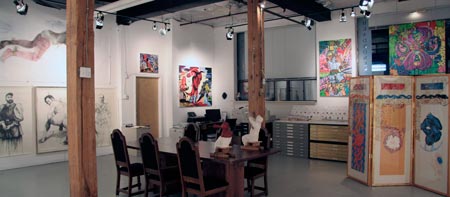 NEOPRIEST
- CHAPTER 2
- 1 The identification of an aesthetic can serve various positive purposes.
- 2 The naming - in this case neopriest - grants an opportunity to take a breath, and contemplate, distancing from the art object in order to place it in relation to historical and philosophical positioning.
- 3 For the artists, it affords an objective from which to consider why the name is applicable.
- 4 For the appreciator, it allows for roads of association to be travelled that might not have been self generated and thus also discover the aesthetic that runs within these works and from there discern the correlations.
- 5 To the art writer, critic and curator, it gives a platform upon which to comment, theorise, criticize and organise.
- 6 For some, it increases the already rich fog that surrounds the art object, increasing mystique and like a sauce, adding a new flavour to an already sufficiently nourishing dish.
- 7 The naming of an aesthetic presents ruminating possibilities hitherto undiscovered and in this respect can be pronounced a viable exercise in thought.
-
 8
The grouping of the works as neopriest is circumstantial and in so
declaring this fact there is acknowledgement that there are most
certainly more neopriest works out there than the perpetrators of the
denomination have time to access. For the time being, the group of
artists is this, in alphabetical order (a non-hierarchical
classification of 'before' or 'after'): Aleks Bartosik, Osvaldo Ramirez
Castillo,
Billy Copley,
Scott Ellis, Scott McEwan, Robert Farmer, Ed Giordano Jr, Ashley
Johnson, Zachari Logan, Jesse McCloskey, Julie Oakes, Srdjan Segan and
Jenny Wing Yee Tong. Thirteen to date - but the number is irrelevant
(falling into the circumstantial arena like the alphabetical order),
nothing mystical or ordained.
8
The grouping of the works as neopriest is circumstantial and in so
declaring this fact there is acknowledgement that there are most
certainly more neopriest works out there than the perpetrators of the
denomination have time to access. For the time being, the group of
artists is this, in alphabetical order (a non-hierarchical
classification of 'before' or 'after'): Aleks Bartosik, Osvaldo Ramirez
Castillo,
Billy Copley,
Scott Ellis, Scott McEwan, Robert Farmer, Ed Giordano Jr, Ashley
Johnson, Zachari Logan, Jesse McCloskey, Julie Oakes, Srdjan Segan and
Jenny Wing Yee Tong. Thirteen to date - but the number is irrelevant
(falling into the circumstantial arena like the alphabetical order),
nothing mystical or ordained. - 9 Each artist could have a different idea in mind when applying neopriest to his or her art work, but there is a resonance, a willingness to be considered under this heading and varying latitudes of acceptance.
- 10 Since there was intended to be nothing binding in the grouping, this works well for all.
- 11 Neo connotes a previous generation, the older, that the new has descended from. In this case it does not mean 'emerging' or nascent but refers to historical comparisons and precedents.
- 12 There is a maturity to the works of each of the artists; they have all fully arrived, been 'outed', blooded, vetted and assumed rank.
- 13 The acronym most applicable seems to be Pop Realists Intellectually Engaged in Story Telling and each of the words is coloured in varying tones, hues and brightness in relation to the works.
-
 14
Some are more saturated with Pop;
Billy Copley,
Osvaldo Ramirez Castillo, Scott McEwan and Robert Farmer all use a
cartoon style and coloring.
14
Some are more saturated with Pop;
Billy Copley,
Osvaldo Ramirez Castillo, Scott McEwan and Robert Farmer all use a
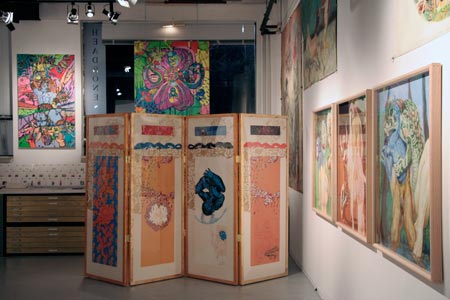
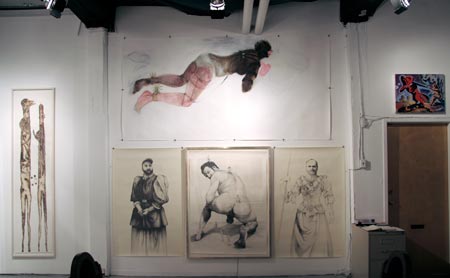
cartoon style and coloring. - 15 Some are stronger in the Realist spectrum; Ashley Johnson, Zachari Logan, Aleks Bartosik and Julie Oakes.
- 16 Some are more heatedly engaged such as Giordano with his inescapable angst or Jesse McCloskey with his expressionistic handling.
- 17 Others are cooler, more analytical, like Scott Ellis' carefully constructed manipulations of imagery taken from media sources.
- 18 All are telling stories and are intellectually engaged. Some repeat the same characters and plot lines like Jesse McCloskey with his girl/witch and dog/devil or Srdjan Segan with the innards of his stretched men being exposed, again and again, or Jenny Wing Yee Tong with her donkeys lit by antique chandeliers causing swoons.
- 19 But all of the works contain some of the ingredients of this acronym.
- 20 The reference to the real is always present. None of these artists have left the representational and abandoned themselves to abstraction although there is also an element of abstraction running throughout.
- 21 Space also becomes pertinent in McCloskey's and Copley's work with the picture planes receding and advancing - but they are the exceptions. For most, figure on ground reigns against shallow perspectives.
-
 22
It is of note that there is an adherence to traditional mediums, that
primarily the neopriest practice is producing paintings and collage
works. McCloskey, Copley, Segan and Wing Yee Tong all employ an
expressionistic handling of the material.
22
It is of note that there is an adherence to traditional mediums, that
primarily the neopriest practice is producing paintings and collage
works. McCloskey, Copley, Segan and Wing Yee Tong all employ an
expressionistic handling of the material. - 23 There is a metaphysical bent running through the aesthetic. The ghostly and ghastly make appearances.
- 24 Jesse McCloskey calls upon New England witch hunts; Johnson, the shamanism and primitivism of Africa; Oakes, Buddhism and the apocalypse; Wing Yee Tong, fairies, fantasy and midsummer night's dreams; Segan, the mythological; Logan, classical and Christian constructs; Castillo, Aztec Gods; Bartosik, Amazon women exhibiting a pantheistic display of curiosity; while Scott McEwan invokes the psychedelic states. Even Scott Ellis, with all of his repercussive immediacy calls up the three realms of Heaven, Earth and Hell. Ed Giordano's enigmatic Father Domini or his crucifixion imagery is clearly an outbreak of confessional guilt.
- 25 Copley steers clear - unless the great pilgrimage of consumerism, brought to iconographic singularity with his shopping bags could be deemed a contemporary metaphysical orientation.
- 26 There is very little of the jaded outlook or detached irony that has been a telling mark of the post-modern era within the neopriest aesthetic and here the relationship to the word 'priest' is brought forward.
- 27 Juice courses through the veins of the corpus of this aesthetic, pumped by undaunted commitment to the work.
-
 28
The artists, acting much like priests, serve as mediators between the
great spirits and the growing congregation of those who have found their
way into the Church of Fine Arts.
28
The artists, acting much like priests, serve as mediators between the
great spirits and the growing congregation of those who have found their
way into the Church of Fine Arts. - 29 Neopriest shows dedication in the artistic practices that have transcended the commonality of quotidian rounds to partake in faithful rituals that make art happen.
- 30 The obsessive, stridently focussed practices of these artists are a testament to their calling where each observes a near religious adherence to production with personal genuflections to varying principles, be they specific or as general as human rights and righteous indignation.
- 31 The clearing aside of all other duties and distractions to live the monastic life of the artist sequestered in the studio, the confrontation between the self and the reason for existence, the telling of knowledge through the physical body of work - many apt associations can be drawn between religion and art.
- 32 And there is the obvious; that art serves as the conduit for the un-see-able, assisting in the difficulty of believing by exercising slights of hand.
- 33 Neopriest is new - a spark of life more than a crowning glory. The term, neopriest, is a light touch of a verbal wand. Nothing more. A godmother has anointed heads and sparkle dust is beginning to whirl with faceted brilliance causing reflections.
- 34 This is not an opening act with explosions, fireworks and didactic predispositions but a subtle insertion, a glimmer of insight.
Copyright © 2009, Julie Oakes